conservation
research & diagnosis
vulnerabilities in glass
mechanical stress
The build-up of mechanical stress in glass may be due to glass type, variations in the melt’s chemical composition, conditions during annealing or the object’s shape and dimensions. Internal stress can also make glass vulnerable.
Internal stress causes a different type of light refraction, known as double refraction (birefringence), which splits a single ray entering the glass into two beams with different polarisation directions, making mechanical stress visible. Stress can be examined using two polarising filters (a laptop screen can serve as one). Vertically align and rotate the filters until they produce a dark transmission. Place the glass between them. Any blue patches indicate where stress is present in the glass.
The area just below the lip rim is vulnerable in some glass objects because it is where internal stress can build up, potentially leading to fracture directly after manufacture or much later. The drinking glass shown here is part of the SBHK study collection.
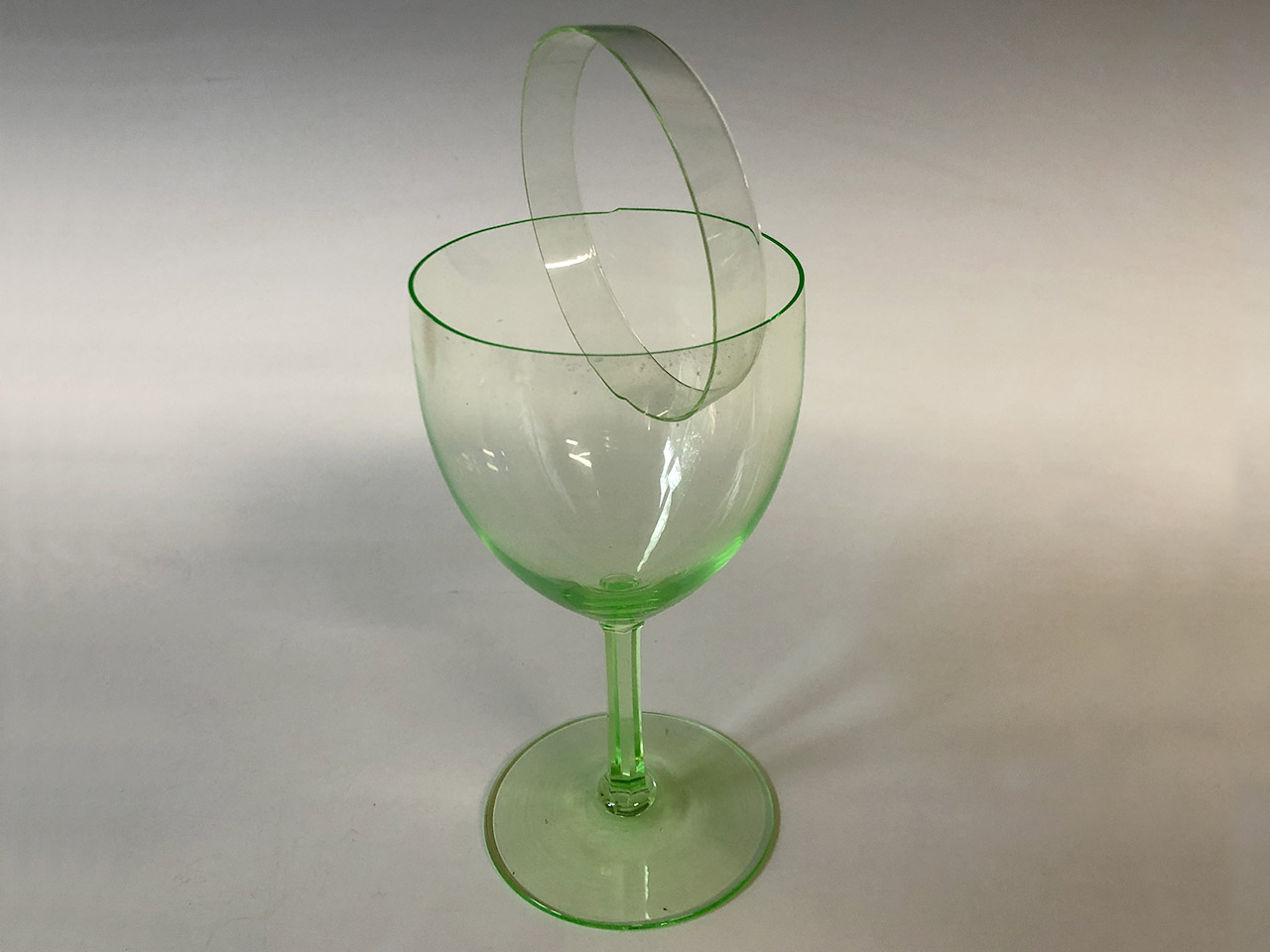 Annagrün glass, mould-blown, cut and drawn stem and foot, ground and polished stem. The rim has broken off due to stress in the glass. PHOTO A. Carlgren, collection Vrij Glas
 Visualisation of stress in a glass object. PHOTO M. Slager
Nickel sulphide inclusions
One cause of spontaneous fracture in toughened glass is the presence of nickel sulphide (NiS) inclusions. These impurities can remain in the glass due to inadequate quality control during production and have a different coefficient of thermal expansion to the surrounding glass. Significant temperature fluctuations can create stress in the glass, which in some cases can lead to fracture.