conservation
advice & treatment
cleaning unstable glass
The glass surface undergoes significant changes as a result of atmospheric degradation. An outer layer forms whose physico-chemical properties differ from those of the glass core. The formation of salts and/or cracks impairs the aesthetic qualities of the glass. Moisture adbsorption and salt formation on the surface make the glass vulnerable to further degradation processes. The salts on the surface are hygroscopic and attract moisture and other contaminants from the air. It is therefore important to measure ion concentrations, remove the salts and continuously monitor the object’s condition.
Removing salts
The fact that moisture is both the culprit and the solution makes the removal of salts a subject of research. Recent research carried out on artificially aged unstable replica glass indicates that rinsing glass (i.e. running water over the surface) removes salts and significantly slows down the degradation process. Further research is needed to determine the effects of mechanical actions and aqueous cleaning on historical glass from museum collections. (see also:
cleaning glass.)
How often should unstable glass be cleaned?
This question is also under investigation. Almost all glass objects in the Museum Boijmans Van Beuningen collection were cleaned around 2013. Long-term monitoring of the ‘guide group’ will provide insight into the process of degradation after cleaning and possible cleaning strategies. Glass in the advanced or full-blown crizzling categories (see
atmospheric degradation) cannot be cleaned.
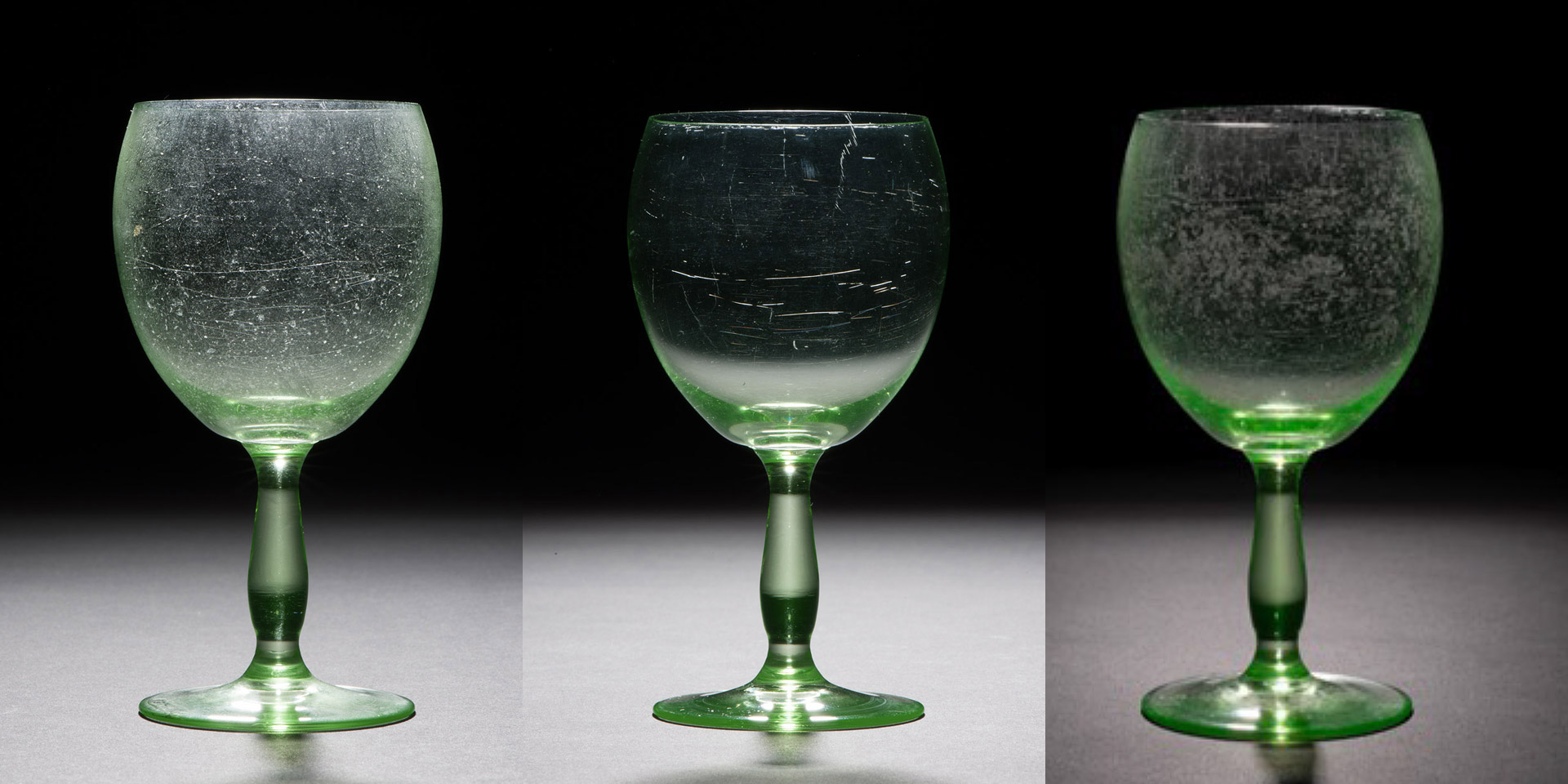 Object V63d (KN&V) COLLECTION Museum Boijmans Van Beuningen. Left to right: object before cleaning in 2013, after cleaning, and in 2024 with droplets/crystals once again visible on the surface. PHOTO The Visual Art Box – Cees de Jonge
Risks of cleaning
Cleaning briefly exposes a glass surface to 100% humidity, followed by drying within a limited time. The object must be handled extensively during cleaning. This is not without risk, as the following case study demonstrates. While drying, and without anyone coming into contact with it, the object shattered into pieces. The cause remains unknown. The object may have contained instability whose signs were not yet visually detectable, or the cleaning process may have caused the breakage. The shards from this object and a similar intact object have been included in the guide group at Museum Boijmans Van Beuningen and are being closely monitored.
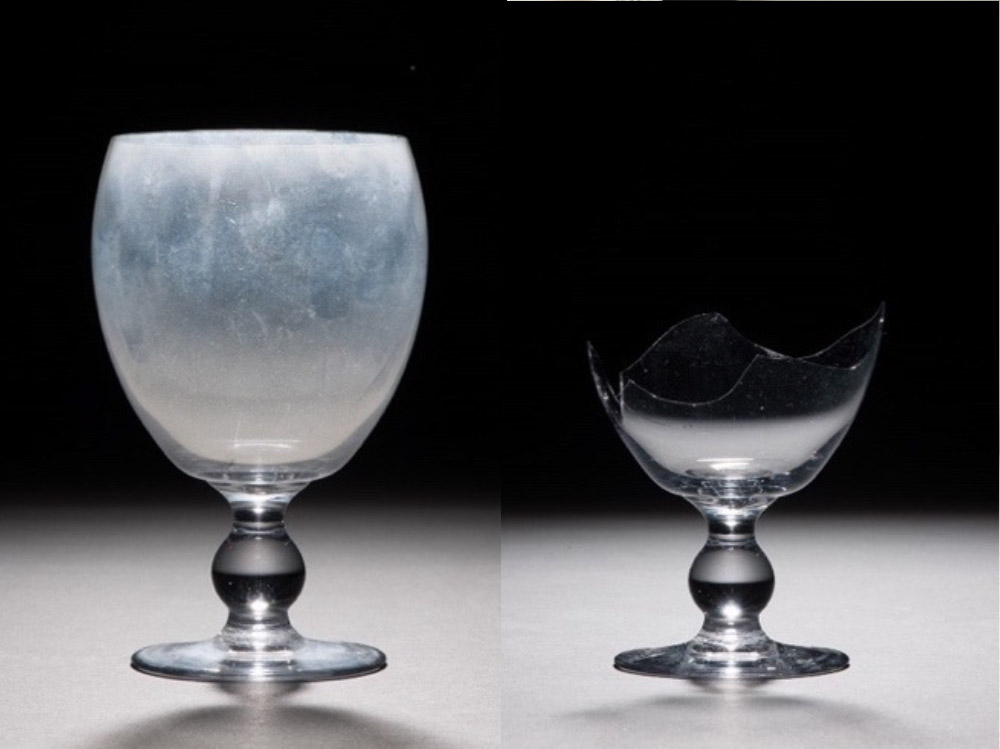 Object V63a1 (IKN&V). Collection Museum Boijmans Van Beuningen. Before and after cleaning. PHOTO The Visual Art Box – Cees de Jonge
 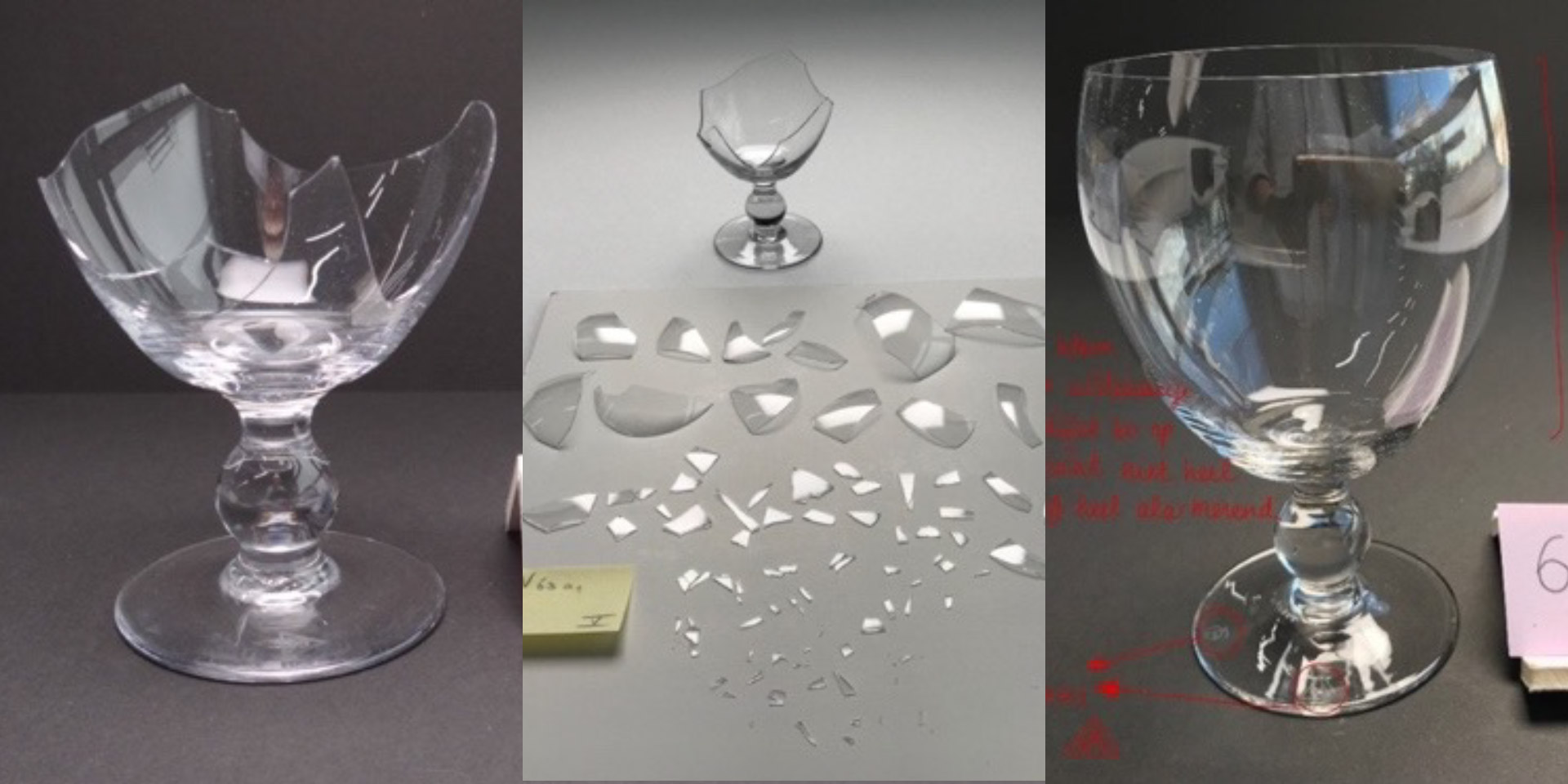 Broken object V63a1 and comparable object V63a2. PHOTO M. Slager, 2024